
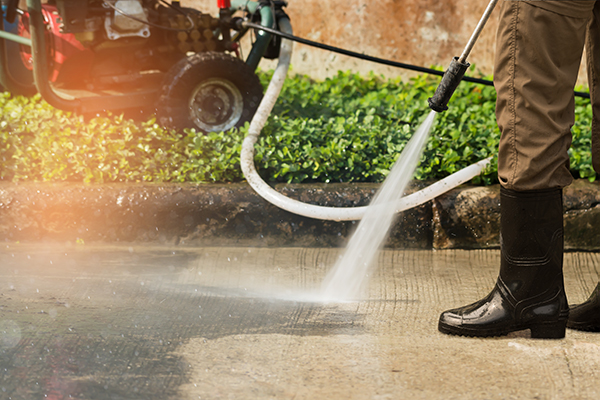
The pressure washing industry is multi-billion-dollar business. More service providers, such as carpet cleaners and restoration companies, are incorporating high pressure cleaning into their operations. These services can make you a lot of money, from gum removal to mobile vehicle cleaning services to exterior and masonry cleaning and even trash can clean —
There has been a lot of interest lately in high pressure detergent recommendations. This article will discuss the science behind cleaning high-pressure washing machines.
You may have ever seen a client out on the field complaining about high-pressure cleaning and wondered why it wasn’t getting cleaned. Due to the equipment used and the soil types, there is a huge difference in how detergents are applied to carpets and in restoration.
There are three main reasons a surface may not be completely cleaned when using a pressure washer to clean it.
- The technician uses the wrong detergent
- Although the tech is correctly using the detergent, he is not using it correctly.
- The tech isn’t using the detergent-based cleaning power at all
Many times, fundamentals of cleaning and the science behind soil bonding, detergent usage, are not understood.
It’s best to keep the science of cleaning super simple when we examine it. Understanding the science behind high-pressure cleaning requires that you understand several concepts.
- These are the four basic principles of cleaning
- Equipment for pressure washing
- The fundamental nature of soils
- The nature of sub- or surface substrates
- Water conditions available
- Selection of detergents
Four fundamental principles of cleaning
This information is not only important for cleaning success, but many in the industry know it.
Sometimes, the four basic principles of cleaning can be represented by the cleaning pie or the CHAT. These are the four fundamentals of cleaning, no matter what they’re called.
One of the most important is chemical actions. Add detergents to your cleaning system and they will break down and suspend soils faster than water alone. The type of soil, substrate, and water conditions are all important factors in choosing the right detergent. Also, the cleaning agent must be properly diluted and applied.
temperature is another piece of the pie – this refers to the temperature of water used. You should choose a detergent that works with the temperature of the water the technician uses.
The mechanical actions are next. In high pressure cleaning cases, this is often angle and impact force. Some type of mechanical action must be used, such as impact force or additional scrub, to stir the chemical into the substrate. This will allow it to surround the soil, break it down, dissolve or suspend it, so it can then be rinsed off with the action the lance.
time is the last piece of this pie. There are many things that this refers to, but it is usually dwell time. This is the time the detergent must be in contact the soils for it to do its job. Some detergents require a certain dwell time to interact with soils and emulsify them or suspend them so that they can be released from the substrate.
These four fundamentals of cleaning are subject to a specific rule. You must increase or decrease one of these four fundamentals in order to make it more effective. For example, let’s say that the technician hasn’t used the right amount of chemical action. He may have diluted the detergent incorrectly. He will have to increase the temperature or mechanical action of the water in order to clean properly. The incorrect use of detergents will make the cleaning process more difficult and will result in a longer time frame.
Use the right detergent to reduce costs in productivity, water consumption, and fuel costs.
Let’s now look at the four basics of high pressure cleaning in gold coast.
Soil nature in high pressure cleaning
It is essential to know the basics of soils in order to select the right pressure washer detergent. This may seem simple to those who have been cleaning for a while, but we are trying to make things easy.
This generalization of soil helps us quickly select the right pressure washer cleaning detergent based upon pH. This is a great place for detergents of this type.
We will be separating organic and inorganic soils when high pressure cleaning. This tactic is not recommended for upholstery or carpet cleaning. There are many more complicated soils and soil bonds, as well as detergents that have been developed for these projects.
You will need to determine the soil type in order to choose the right detergent. This will give you information about how to choose the right pressure washer detergent based upon pH.
Clays, minerals build-up such as lime scale, calcium water deposits and sand, dust and rock are all examples of inorganic soils. Also included are stains such as rust, corrosion and other forms oxidation. These soils might not be easily soluble. We use water-based cleaning products based on pH to remove them. Then we suspend them in the cleaning phase.
Organic soils are made from animal fats, blood, excreta, blood, vegetable oils and most food products as well as bacteria, mushrooms, and slimes.
We may use a mixture of both organic and inorganic soils in many cases. We need to examine the detergent formula more closely to determine if this is the case.
The basics of pH
The formulation of detergents does not include pH. Other cleaning agents may be added to the formulation, including surfactants to lift soils and blended solvents to breakdown oil and greases. There are also water conditioning agents and chelating agents that aid in organic soil removal. There are many cleaning agents in the mix, but pH is the best place to start in determining which detergent is the best for high-pressure cleaning jobs.
People like to refer pH to the detergent’s cleaning power. The pH scale is used to measure acidity and alkalinity. It helps soils be broken down. It’s not that one side is stronger than another on the pH scale. There are two sides to the scale: acid and alkaline. Most cases can be determined based on pH.
This is how you can choose the right high pressure detergent for your project.
- Choose a detergent that is acidic to remove organic soils
- Choose an alkaline detergent to remove organic soils
There may also be other factors such as metal dust, factory lubricating oil, or excrement from an animal holding pen. These projects may require you to choose the detergent based upon pH and then select the best formulation for your cleaning needs.
The pH range
We often teach the pH scale to those in the restoration and cleaning industry. It ranges from 0 to 14.
- A pH of 7.0 is neutral. This is usually the pH of distilled waters.
- The acidic side is between 0 and 7.0.
- Any pH greater than 7.0-14 is considered alkaline.
The pH scale can be described as a logarithmic scale. This means that for every jump from 7.0 (or neutral), the pH (or possible detergent cleaning strength) becomes stronger in acidity and/or alkality depending on the side of the scale.
A detergent with a pH 4 on the acid side of this scale is 1000 times more powerful than cleaning with water or a product that is pH 7.0. A detergent with a pH of 3 is stronger, because it is closer to 7.0 or neutral.
On the other side of the scale, the same applies. It is generally 10,000 times more effective to clean with alkaline detergents with a pH of 11. It is easy to see how detergent pH can have a positive effect on cleaning.
For proper detergent dilution, I suggest that you carefully read the label of the manufacturer.